Service line
Particle
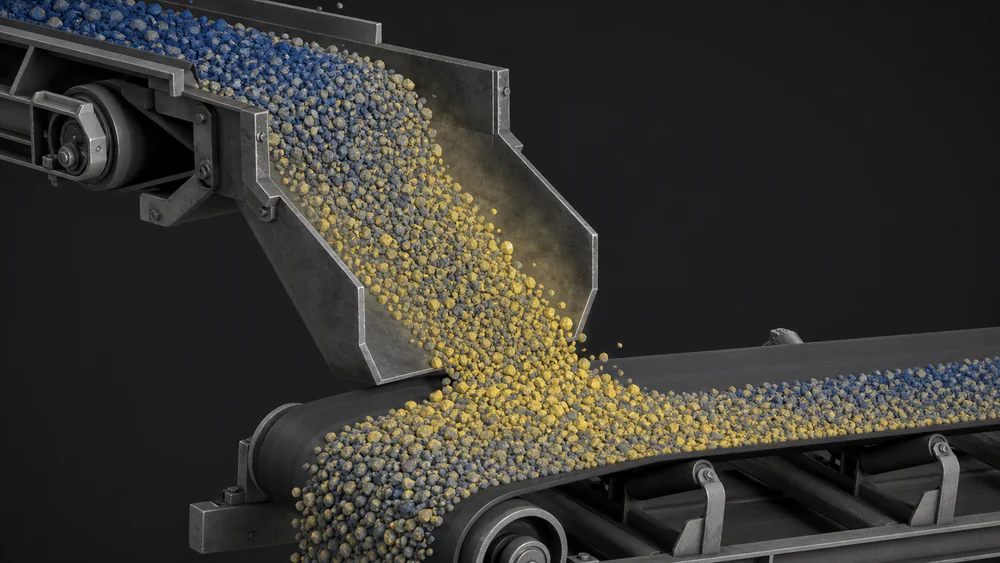
DEM for chutes, conveyors and milling
Discrete element method
- Chute design and redesign
- Wear and segregation
- Calibration with site material
Build the scope in three steps
Assets we model
- Transfer chute
- Conveyor and loading point
- Mill or screen
- Stockpile or storage
Typical scope
- Calibration with site material: angle of repose and box discharge
- Geometry of the chute, the skirt and the receiving conveyor
- Sensitivity to particle size and moisture
Deliverables
- Trajectories, relative wear and spillage balance
- Record of the calibration and its tests
- Report with the conclusion on the first page
Notes in this line
- An uncalibrated DEM model is an animation, not a calculation Which bench tests constrain each contact parameter, the order they are fitted in, and why a calibration only holds inside the envelope it was tested on.
- A run without a mesh study is not a result What a mesh sensitivity study is, how we document it with GCI, and what y+ actually means when you decide where the first cell goes.