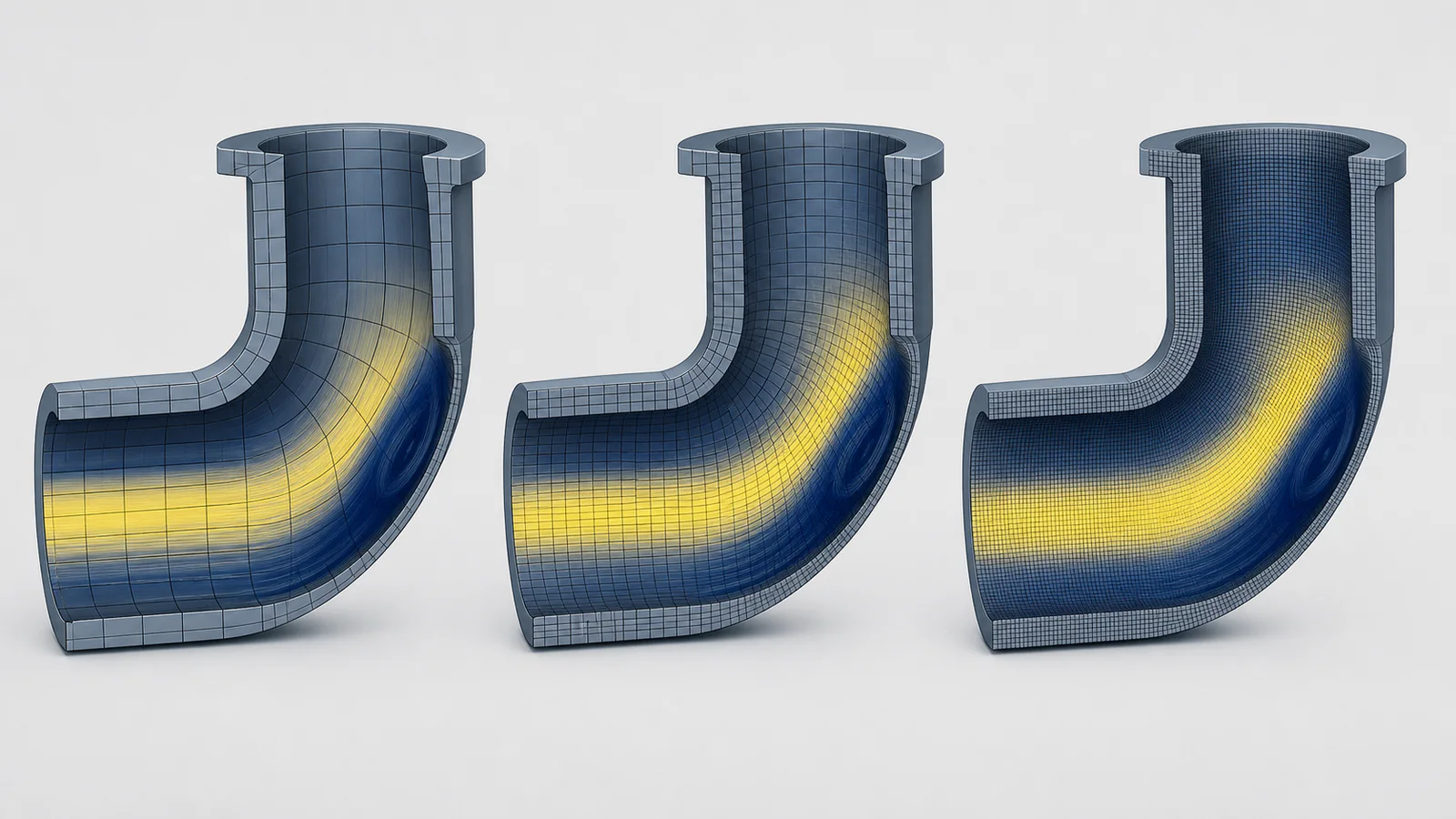
Every run returns a number. That number depends on the physics you selected, on the boundary conditions, and on the mesh. Until the third is separated from the first two, there is no result. There is a run.
This is not a fine point. A discharge rate, a pressure drop or a peak stress all move with discretisation, and they move in a direction you cannot guess from the picture. The mesh is a model parameter, not a preprocessing step you hand to the automatic mesher.
Three meshes, one scalar
A mesh study is defined before meshing, not after the result becomes inconvenient. The order never changes:
- Pick the quantity of interest first. One scalar, the one that moves the decision: total pressure drop, peak stress in the critical section, mass flow at the outlet. If the decision rests on three quantities, the study covers all three and the worst one is reported.
- Three meshes with systematic refinement. The refinement ratio
rbetween representative cell sizes stays above 1.3, the minimum recommended in ASME V&V 20 so the difference between meshes is distinguishable from solver noise. Systematic means same topology, same boundary layer strategy, same solver settings. Onlyhchanges. - Compute the observed order
pfrom the three values and compare it against the formal order of the scheme. Ifplands far from it, the study never reached the asymptotic range and the extrapolation does not apply. - Report GCI on the fine mesh,
GCI = Fs · |ε| / (r^p − 1), withFs = 1.25for a three-mesh study. GCI is a numerical uncertainty band in the units of the result, and that is how it enters the report:184 MPa ± 2.1 %from discretisation.
Monotone convergence and oscillatory convergence are not the same thing. When the three values oscillate, Richardson extrapolation does not apply. Say so; do not average.
What gets documented
A mesh study is worth something only if someone else can repeat it. The deliverable carries the cell count and representative h for each mesh, the ratio r, the three values of the scalar, the observed order, the GCI on the fine mesh, the mesh used in production, and the quality metrics that came with it: maximum skewness, maximum non-orthogonality, aspect ratio in the boundary layer.
y+ is not a checkbox: it is where the first cell lands
y+ = u_τ · y / ν is the dimensionless distance from the first cell centroid to the wall. Three things get lost regularly.
First: y+ is an output, not an input. It depends on the friction velocity, which depends on the solution. You estimate it from a skin friction correlation, mesh, run, and check. There is almost always one remesh.
Second: there are two valid regimes and a band between them where neither holds.
| REGIME | FIRST CELL y+ | WHAT IT RESOLVES | WHEN TO USE IT |
|---|---|---|---|
| Wall resolved | ≈ 1, with 10 or more cells below y+ 30 | Viscous sublayer and buffer layer | Wall shear, heat transfer, separation |
| Wall function | 30 → 300 | Log layer, with an assumed profile below it | Global pressure loss, fields away from the wall |
| Buffer band | 5 → 30 | Neither: no resolution, no valid log law | Avoided; continuous treatments interpolate, they do not resolve |
Third: y+ is a field, not a number. A mean of 45 can hide a stagnation region at 3 and a leading edge at 180. We report percentiles over the surface that matters — median, p95 and maximum — and show the map whenever the decision lives at the wall.
What a mesh study does not prove
A converged global scalar does not imply a converged local gradient. Pressure drop can be stable within 1 % while peak wall shear still moves 15 % between meshes.
In structures there is one case that never converges: the singularity. At a re-entrant corner with no fillet, stress diverges under refinement by construction of the continuum model, not because of a numerical defect. You do not run a mesh study on that node. You model the real fillet, or you linearise stress along a defined path, and you state which of the two you did.
And the part that matters most: mesh independence removes one source of error, the cheapest one to remove. It does not repair a badly chosen turbulence model or a wrong boundary condition.
A mesh study costs two extra runs. A result without one costs the decision that was made with it.