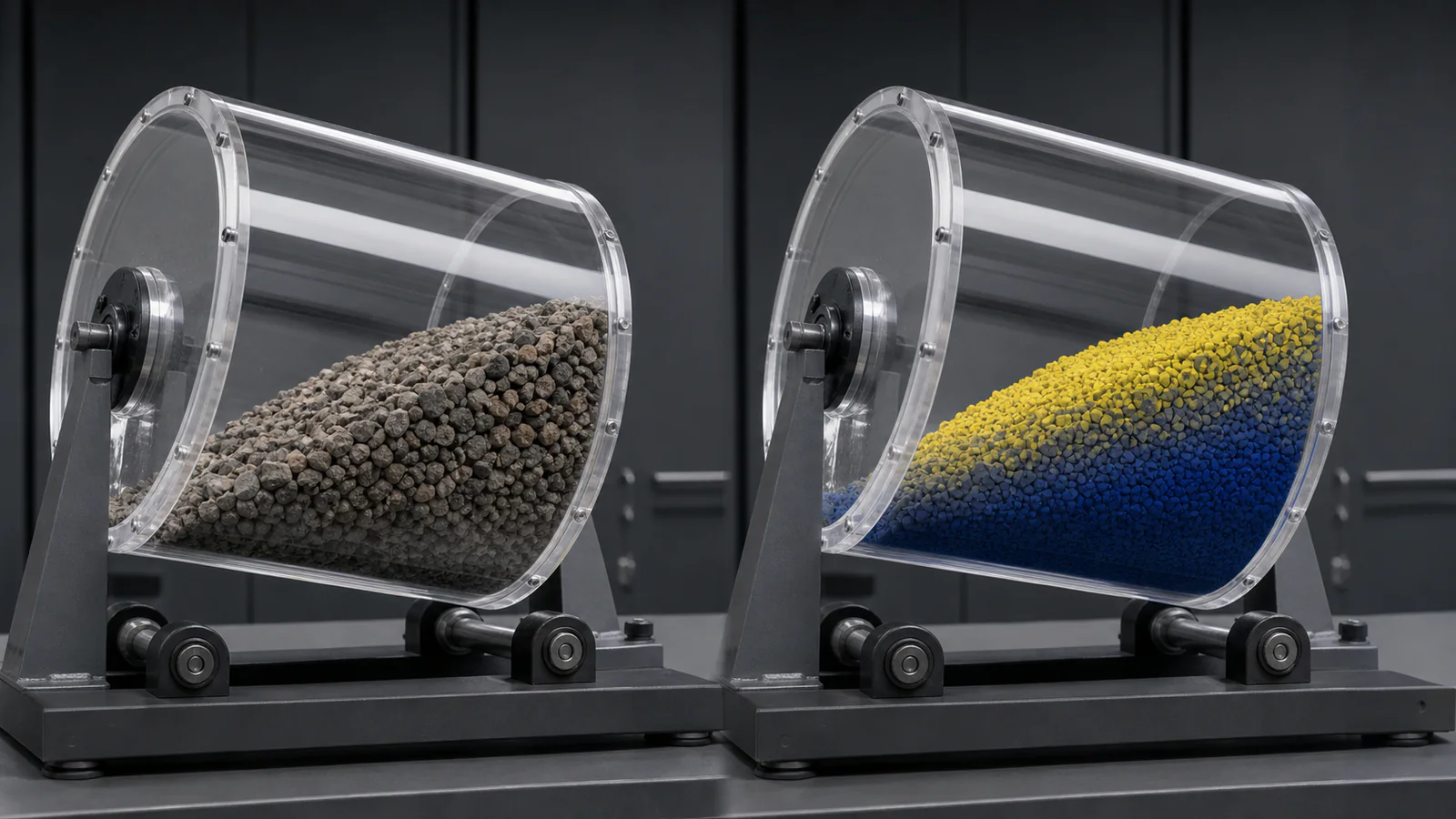
In finite elements, Young’s modulus for steel comes off a table. 200 GPa is a measurable material property and it transfers from one model to the next without argument.
DEM has no such privilege. Contact stiffness, restitution, sliding friction, rolling friction and cohesion are not properties of the ore. They are properties of the numerical particle, and that particle — a sphere or a clump a few centimetres across — does not exist in the pile.
Why you cannot just measure it
A production run of a transfer chute uses particles far larger than the real fines and stiffnesses reduced by orders of magnitude. That is the only way the model finishes in days rather than months. But the moment you scale, any measurement taken on a single grain stops transferring.
The practical consequence: calibration does not fit particle properties, it fits bulk responses. And it needs more than one response, because the map from parameters to a single measurement is not injective. A repose angle of 37° is reproduced by many combinations of rolling and sliding friction, and each of them discharges differently.
The tests and what each one constrains
Material is sampled on site, quartered, characterised by particle size distribution, and its moisture is measured on the day of the test. A sample that spent two weeks travelling in an open drum is no longer the material under discussion.
| TEST | RESPONSE MEASURED | PARAMETER IT CONSTRAINS |
|---|---|---|
| Repose angle · lifted cylinder or drum | Static and dynamic angle | Rolling and particle-particle friction, coupled |
| Shear cell · Jenike, annular or rotational | Yield locus, internal friction, cohesion under consolidation | Cohesion and internal friction |
| Bulk density and compressibility | Packing as a function of stress | Clump shape and friction |
| Wall friction against the real liner plate | Wall friction angle | Particle-wall friction |
| Drop test onto a liner coupon | Coefficient of restitution | Normal restitution |
| Hopper discharge · flow rate | Mass flow rate and flow pattern | None → reserved for validation |
The last row is the rule most often broken. Once the discharge test is used to fit, it can no longer verify, and the calibration loses the only independent check it had.
The order of the fit
- Sensitivity screening. A design of experiments over the plausible range shows which parameters actually move each response. In dense slow flow, restitution barely registers; in free fall and impact, it dominates. Normal stiffness has little influence as long as overlap stays small.
- Simultaneous fit against two or more responses. Fitting one at a time hides the coupling: you close the repose angle and open up the bulk density.
- Validation against a test that never entered the fit. If the discharge rate lands 20 % off, the calibration failed even when the repose angle closes within 1°.
Reduced stiffness and time step
Real rock stiffness drives the Rayleigh critical time step down to the order of nanoseconds. So contact stiffness is reduced and the model runs at 20–40 % of the critical step.
That reduction holds as long as the flow is not stiffness-dominated and overlap stays small. The usual working limit is a mean overlap below 1 % of the particle radius, checked as a distribution at the end of the run rather than assumed at the start. The reduction factor is a documented modelling decision, not a setting buried in the input deck.
Every calibration has an envelope
A calibration is valid for the size distribution, moisture, consolidation range and wall material it was fitted against. The same ore at 8 % moisture is not the same material as at 2.5 %: cohesion moves considerably more than the tolerance of the fit. Winter and summer, ROM and crushed, a steel liner and a UHMW one are different cases. Either you recalibrate, or you state the extrapolation and the risk that comes with it.
That is why the deliverable carries the fitted parameter table, the tests with their conditions, the residual on each response, the validation result and — explicitly — what was not calibrated.
Without that backing the material still moves and the image still looks plausible. What stays a free parameter is everything the model was meant to decide: the forces on the liner, the wear rate, the flow rate and the segregation.