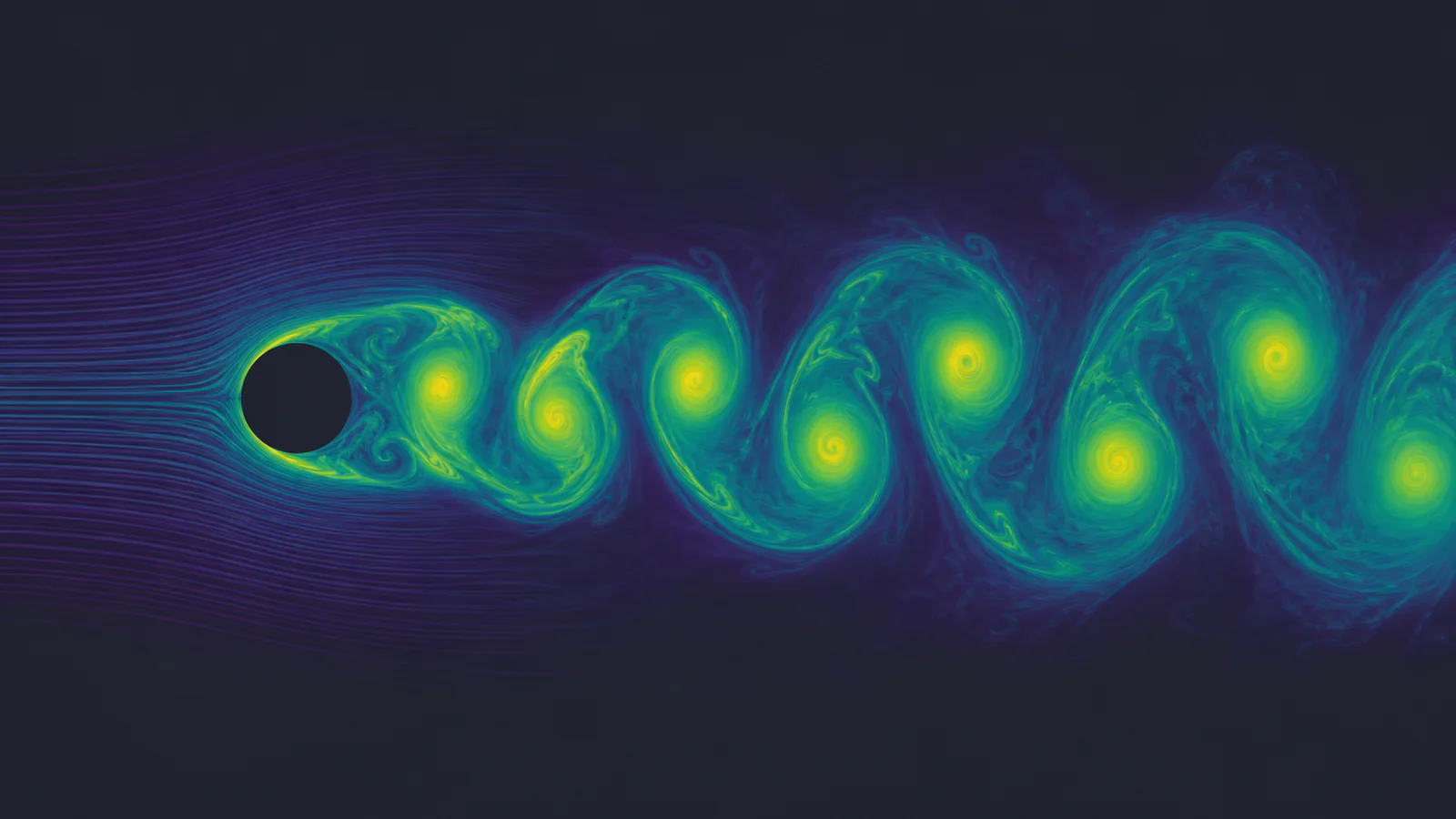
The colour scale is the last transformation between the number and the person making the decision. Whoever reads the report does not measure the field. They look at it. If the scale reorders what they see, the error enters after the whole verification chain and is recorded nowhere.
That is why rainbow and jet are banned here, without exceptions. The argument is not about taste.
Jet’s lightness is not monotonic
The visual system reads brightness as order. Jet runs from dark blue through bright cyan, mid green, bright yellow and into dark red: lightness rises, falls, rises and falls again. You cannot order two colours from the bar from memory. You would have to return to the legend on every glance, and nobody does.
Three concrete defects follow, and all three show up in the same figure:
- False bands. At the cyan and yellow transitions, lightness changes slope abruptly. The visual system sharpens that step, the same way it does with Mach bands, and draws a crisp contour where the field is smooth. The reader sees an interface, a front or a recirculation zone that is not there.
- A flattened range. The green stretch covers a wide portion of the data range with almost no perceptual variation. Information disappears there: a real gradient reads as a flat surface.
- Order that cannot be recovered. Put two figures of the same case at different ranges side by side and comparison by colour stops being valid.
That jet both invents and conceals is not a workshop impression. It has been measured on diagnostic tasks since Borland and Taylor in IEEE Computer Graphics and Applications, 2007, and reviewed for scientific publishing in Crameri, Shephard and Heron, Nature Communications, 2020.
What viridis and cividis do differently
Both were built inside a perceptually uniform space, not by picking colours that look good. The design constraint is that lightness increases monotonically and close to linearly along the bar, so that an equal step in the data produces an equal step in perception.
Three practical consequences:
- Order is readable without going back to the legend.
- There are no false bands, because there are no lightness steps.
- Printed in greyscale, the order survives. Reports get photocopied and appended in black and white; in jet, two different values come out as the same grey.
Cividis goes further: it was derived so that a viewer with deuteranopia sees essentially the same image as a viewer with typical colour vision (Nuñez, Anderton and Renslow, PLOS ONE, 2018). That matters because red-green deficiency affects roughly 8 % of men and 0.5 % of women of northern European descent, and the axis that collapses is exactly the one jet uses for its endpoints. In a review meeting of twelve people, the odds that someone cannot read the figure are not small.
| SCALE | LIGHTNESS | DEUTERANOPIA | GREYSCALE PRINT |
|---|---|---|---|
| Jet · rainbow | Non-monotonic | Endpoints collapse | Order is lost |
| Viridis | Monotonic | Readable | Continuous ramp |
| Cividis | Monotonic | Readable by design | Continuous ramp |
| Diverging | Symmetric about the centre | Readable | Partial |
The assignment follows from that table: viridis on screen, cividis in print and appendices, and a diverging scale only when the field is signed and zero means something physical.
The scale is fixed before export, not after
The rules we apply to every result figure:
- Fixed range across every frame of a comparison or an animation. With per-frame autoscaling, colour changes because of rescaling and the eye reads it as physics.
- Unit and range visible on the bar. A field without a unit is a texture.
- Declared clipping. If we cut at the 99th percentile so a singular node does not consume the scale, the caption says so.
- Discrete banding only when the reading is a level set; an isoline over a continuous scale is almost always better.
- Diverging scale only when zero means something: pressure relative to a reference, signed displacement. Over a strictly positive field, the perceptual centre lands on an arbitrary value.
- A decision threshold is never encoded in colour alone. If the question is whether 184 MPa is exceeded, the 184 MPa isoline goes on the figure. No scale lets anyone tell 184 from 190 by eye.
The same field, in jet and in viridis, leads two readers to two different conclusions. Only one of them is in the data.